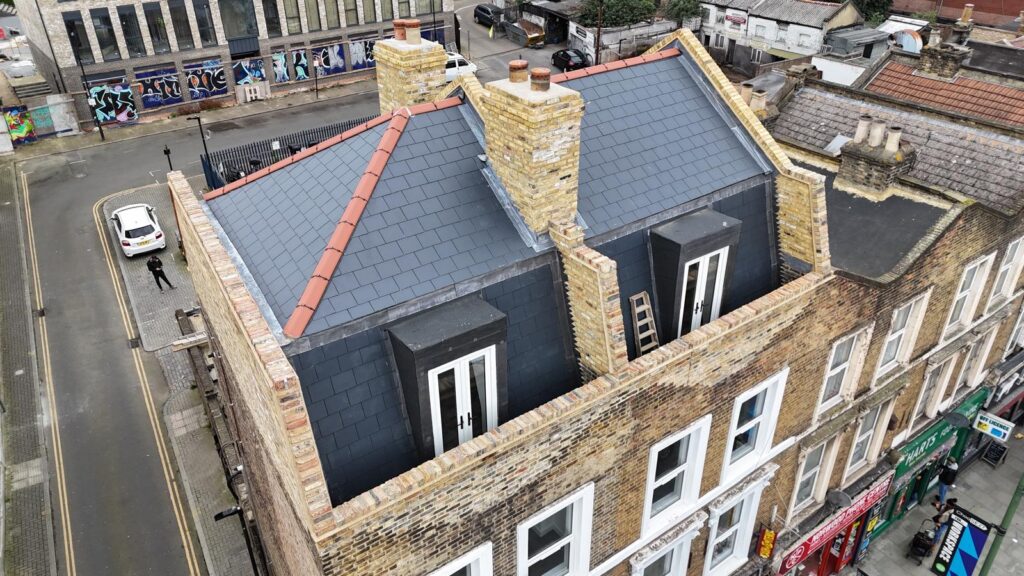
At this property in London, we were asked to inspect ongoing water ingress issues linked to a fiberglass flat roof that had been installed badly in the past. The inspection also revealed external wall damage, with a visible crack forming where the render had failed and allowed moisture to get in.
This project highlights the problems that can develop when a flat roof is not fitted correctly, especially around the edges and patched areas. It also shows why acting early is so important when signs of water damage start to appear.
Property Details
Property Address: 51 Hargwyne Street, London, SW9 9RQ
Date of Inspection: 31/03/2026
Inspector: Jason Mamo
The Problem
When we inspected the property, it was clear that the existing fiberglass flat roof had deteriorated badly. Several previous patch repairs had failed, and water was getting through the roof covering. The perimeter sealing had also been carried out poorly, leaving vulnerable points around the edges.
On top of that, pooling water had added more stress to the roof surface over time. Instead of draining away properly, standing water had been allowed to sit on the roof, which accelerated the wear and exposed weaknesses in the failed patched sections.
We also identified a vertical crack on the external wall. The render in that area had broken down, creating a route for water to seep into the wall structure. Left untreated, this kind of issue can worsen quickly, especially during periods of heavy rain.
What We Found During the Inspection
Our inspection showed two main defects that needed to be addressed.
Failed Fiberglass Flat Roof
The fiberglass roof had been poorly installed previously and was no longer providing reliable waterproof protection. Multiple worn patch repairs were visible, and water ingress was already taking place. The edge detailing had not been sealed properly, which is one of the most common causes of flat roof failure when workmanship is not up to standard.
Pooling water on the roof had made the problem worse. Over time, standing water can exploit weak points, break down failed joins, and increase the likelihood of leaks into the property below.
Cracked External Wall and Failed Render
A vertical crack had opened up on the exterior wall, and the surrounding render had deteriorated. Once the render failed, the wall became more exposed to moisture penetration. This was not just a cosmetic problem. Water entering through cracked render can lead to further damage internally and externally if it is not repaired properly.
Our Recommended Solution
To resolve the problems fully and avoid repeat issues, we recommended a full replacement of the defective flat roof system rather than another temporary patch repair.
Scope of Works
Remove the existing roof
The faulty fiberglass flat roof would be stripped back completely and all waste materials removed from site.
Reboard the roof structure
New boarding would be installed to create a sound, stable base for the replacement roof covering.
Install new lead flashing
The perimeter lead flashing would be replaced to improve edge protection and create a proper watertight finish.
Lay a new rubber membrane
A new rubber roofing membrane would be installed to provide long-term waterproofing and a more reliable flat roofing solution.
Repair the external wall crack
The damaged render would be removed, the wall repaired using a lime-based mix, and the area repainted in a matching white finish.
Why This Approach Was Recommended
This was not a case where a minor repair would have been enough. The existing fiberglass roof had multiple points of failure, and the workmanship issues around the perimeter meant that any small repair would only have delayed the problem rather than solved it.
By stripping the roof back fully and rebuilding it with new boarding, lead flashing, and a rubber membrane, the property would benefit from a roof system designed to stay watertight over the long term.
The wall crack repair was also important. Once render starts to fail and moisture gets in, the damage can spread. Removing the defective material and carrying out a proper repair with the right mix would help protect the wall and restore its appearance.
Expected Outcome
Once the recommended works are completed, the flat roof should be fully watertight and far better protected against future leaks. The replacement roofing system will provide a stronger and more dependable finish than the previous installation.
Repairing the cracked render on the wall will also help stop further water penetration and improve the outside appearance of the property.
Most importantly, acting now will help prevent further internal damage, avoid more costly repairs later, and restore confidence in the roof’s condition.
Our Final Say!
This inspection at 51 Hargwyne Street, London, showed how poor flat roof installation can lead to water ingress, failed patches, standing water issues, and damage to surrounding parts of the property. In this case, the best solution was to remove the defective fiberglass roof, rebuild the roof structure correctly, install new lead flashing, fit a durable rubber membrane, and repair the damaged external wall.
Taking this approach will leave the roof structurally sound, weatherproof, and built for longer-term performance.